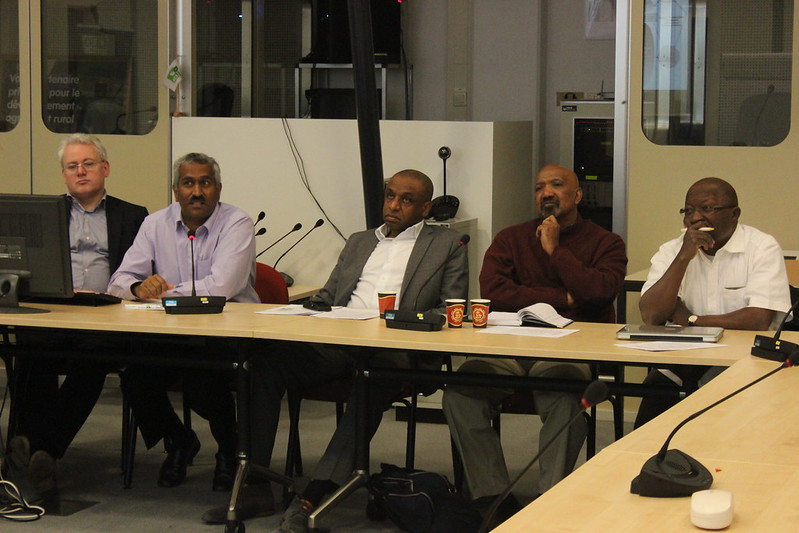
BIOFACH 2016: organic food and the tension between safety and quality

10 - 13 February 2016. Nuremberg, Germany. BIOFACH 2016.
The BIOFACH Congress – the platform for knowledge transfer, information exchange, discussion and opinion forming – is the biggest organic congress in the world and its some 100 presentations and panel discussions reach more than 7,000 participants. Join in the discussion and be inspired!

Key theme 2016: "Organic 3.0 – Acting for more organic!"
Organic 3.0 is the discussion on the organic sector of the future and stands for credible and sustainable concepts which are ground-breaking in the re-structuring of the global agriculture and food industry. The organic movement itself is called upon. But not only that: its partners in politics, the private sector and civil society must also create the conditions for the restructuring process and growth as well as actively support the organic sector. BIOFACH 2016 provides the platform for holding discussions and initiating specific measures.

Extracts of the program:
  • The World of Organic Agriculture - Statistics and Emerging Trends At this session the latest data on organic agriculture worldwide were presented (area, operators, markets) and an overview of the current status of organic legislation will be given
  • EU Policy Day, organised by IFOAM EU in cooperation with BIOFACH. In March 2014 the European Commission published its legislative proposal for a new organic regulation. The next and last step in this process is represented by the ‘trilogue’ negotiations between the three EU institutions to agree on a final legal text, presumably at the beginning of 2016. Taking into consideration the three institutions’ proposals, trilogue outcomes on certain regulation areas can be already foreseen and discussion can be kicked off.The policy day will bring together the EU policy makers and the organic sector to discuss the possible changes that the sector will have to be facing when the new organic regulation is adopted.
  • Recent Studies in Organic Research. This session bridged the gap between science and the public by covering studies published in 2015 (and early 2016) about the human health and environmental benefits of organic agriculture.
  • How much food safety can we afford? The tension between safety and quality. Manufacturers and consumers have been jolted by the discoveries of dioxin and mycotoxins in food products. Does society need to reach a new consensus on safety and quality?
Barbara Altmann, Head of Strategic Sourcing Food Ingredients / Rapunzel Naturkost AG Jutta Jaksche, Verbraucherzentrale Bundesverband e.V. (vzbv)
Dr. Ulrich Mautner, SALUS Haus Dr. med. Otto Greither Nachf. GmbH and Co. KG
Andreas Swoboda, W-E-G Stiftung and Co. KG
Tom Nizet, Responsable certification / Certisys GmbH
Hubertus Doms, Hipp GmbH & Co. Produktions KG

Share
Continue reading

Future of Food Summit 2015 – Aflatoxin

Published on 9 Jun 2015. This panel considers and debates one of the greatest obstacles to food security in many parts of the world: mycotoxin.

Aflatoxin is a particularly dangerous mycotoxin produced predominantly by two Aspergillus fungi. It colonizes a variety of important food and feed crops both pre- and post-harvest, including groundnuts, tree nuts, maize, rice, figs and other dried foods, spices, crude vegetable oils and cocoa.

Contaminated crops have significant health risks for both humans and animals, having been linked to retarded growth and development (stunting), immunosuppression and liver cancer. The aflatoxin issue has other, complex implications for food security and, by limiting farmers’ access to international markets, can lead to food waste and economic instability.

Panelists:
  • John Lamb, Principal Associate, Abt Associates
  • Dr. Kitty Cardwell, National Program Leader, USDA-NIFA
  • Barbara Stinson, Senior Partner, Meridian Institute; Project Director, Partnership for Aflatoxin Control in Africa
  • Moderator: Dr. Howard-Yana Shapiro, Chief Agricultural Officer, Mars, Incorporated
@36:15 Discussion on the funding needs 
@44:33 "The [multi national] agribusinesses that are working in Africa are the ones that want to create clean products. They make it worthwhile for growers to change their practices. Nestle, Mars, Unilever etc can kick start the demand - which is what we need for farmers to do what they need to do [to reduce aflatoxin levels]Dr. Kitty Cardwell
@1:00:48: "Plant science could be a profound way of solving some of those problems" Dr. Howard-Yana Shapiro


Related PAEPARD video interviews
PAEPARD video interview with Howard Shapiro of Mars, Inc USA.

He answers the following questions:
  • Why is the issue of mycotoxin contamination so important? 
  • How critical is mycotoxin contamination for Mars Inc.? 
  • Why do you expect from research and development funders? 
  • Why did the development community not take it up? 
  • Do we need a pre-harvest or post-harvest intervention? Are attitudes changing?
   

PAEPARD video interview with John Lamb; Abt. Associates. 


He answers the following questions:
  • Why the private sector should be concerned about aflatoxin? 
  • The mortality rate among chicken is strong evidence? 
  • How should the chicken feed business be approached?

   
Related: 
CREATED: July, 2015
AUTHOR(S): Mundia Silumesii, Seed Certification and Control Institute SCCI (MAL), Lusaka, Zambia.
EDITED BY: Plantwise, CABI


Share
Continue reading

The State of Agricultural Commodity Markets

The State of Agricultural Commodity Markets 2015–16Trade and food security: achieving a better balance between national priorities and the collective good

This edition of The State of Agricultural Commodity Markets aims to reduce the current polarization of views on the impacts of agricultural trade on food security and on the manner in which agricultural trade should be governed to ensure that increased trade openness is beneficial to all countries. By providing evidence and clarity on a range of topics, the report seeks to contribute to a more informed debate on policy choices and to identify required improvements in the policy processes within which these choices are made.

Key messages
  1. Global trade in food products continues to expand rapidly, but the structure and pattern of trade differs significantly by commodity and by region. Key drivers of production and demand, including trade and related policies, shape these patterns in different ways, with potentially important implications for food security.
  2. Greater participation in global trade is an inevitable part of most countries’ national trade strategies. However, the process of opening to trade, and its consequences, will need to be appropriately managed if trade is to work in favour of improved food security outcomes.
  3. Trade affects each of the four dimensions of food security: food availability, access, utilization and stability. The interaction of trade with these dimensions is complex and depends on a variety of underlying factors, producing great differences in country experiences and making it difficult to ascertain a generalizable relationship.
  4. The relationship between the level of engagement in trade and food security is influenced by the way food markets work, by the ability and willingness of producers to respond to the changing incentives that trade can bring, and by the geography of food insecurity, each of which needs to be accounted for in the formulation of trade policy interventions.
  5. Trade and related policy objectives address different dimensions of food security, will differ across countries, and will change over time. The appropriateness of alternative trade policy options is largely determined by longer-term processes of economic transformation and the role of the agriculture sector within these.
  6. Episodes of food price spikes are important for their potential negative impacts on food security. Geopolitical and weather uncertainties, as well as government responses, are likely to exacerbate these episodes in the future, with increasing potential for disruptions to trade flows. The likelihood of price spikes, even if episodic, needs to be factored into longer-term decisions related to the management of trade in food and agricultural products.
  7. Trade and food security concerns can be better articulated in the multilateral trading system through improvements to the World Trade Organization’s Agreement on Agriculture. However, the right balance needs to be struck between the benefits of collective action brought through disciplines on the use of trade policy, and the policy space required by developing countries, the identification of which needs to be informed by specific country-level needs.
  8. Shifting attention from the pros and cons of specific policies towards addressing weaknesses in the governance processes of agriculture and trade policy-making will improve identification of required policy space and its appropriate use. Strengthening these processes requires building synergies to increase policy coherence for food security, to enable governments to balance priorities in the design of trade policies, and to improve their compliance with regional and global trade frameworks.
Read the executive summary
Download the PDF
Read the e-book IPAD | KINDLE
See the press release
Q&A


Share
Continue reading

Building extension and advisory partnerships in Africa

14-15 January 2016. AFAAS, an organisation for strengthening Africa-wide agricultural extension
and advisory services, has recently reviewed its 2015-2017 strategy, and has identified knowledge management (KM) as a key focal area. CTA’s expertise in KM will help support AFAAS in its new strategic direction.

As well as Dr Nahdy, the AFAAS delegation included Dr Dan Kisauzi, AFAAS technical adviser on knowledge management and communication and Max Olupot Olalatau, partnership officer and technical assistant to the executive director. The team had close discussions with CTA’s technical staff, facilitated by Krishan Bheenick, senior programme coordinator for KM and Dr Benjamin Kwasi Addom, ICT4D programme coordinator. Dr Ibrahim Khadar, CTA’s head of the learning monitoring and evaluation unit, presented practical areas where CTA could support AFAAS including on agricultural policies, markets and value chains, and ICTs for agriculture, learning and KM.

As a process with huge potential for impacting farmers in its new strategy, AFAAS made a
presentation on Country Fora (CF), which are ‘communities of practice’ that bring together a wide range of actors and stakeholders involved in - or benefitting from - rural advisory services in a country. Each stakeholder has an interest in extension but are not necessarily extension workers themselves.
“The CF process can make good use of CTA’s wealth of information for innovations and how to reach farmers. Whether it is information on climate-smart agriculture, value chains or the use of certain ICT tools,” said Dr Nahdy. “Working collaboratively with CTA and our networks for short, medium and long-term sustainability in African countries’ extension and advisory services is key for both CTA and AFAAS,” he added.
Share
Continue reading