The Powerful Eagle

  The Eagle Type: Bird                                              Conservation Status: Least concern Diet: Carnivore                                      Average life span: 28 – 30 years Weight: 3 to […]
Continue reading

African Farming: The Roles of Brazil & China Roles Explained

A special issue of World Development, examines the real roles that China and Brazil are playing in African agriculture, moving beyond what the authors consider as “simplistic narratives of South-South collaboration or neo-imperial expansion”.

Eight papers culled from an input of 20 research collaborators detail how Brazil and China are impacting the African economy. The work, organised via the Future Agricultures Consortium, was supported with roughly US$ 934,000 in UK Economic and Social Research Council funding.

The project set out to explore what is actually going on in Ethiopia, Ghana, Mozambique and Zimbabwe, where Brazil and China have made investments, says Ian Scoones, fellow at the Institute of Development Studies, University of Sussex, the UK, and editor of the issue.

Through 16 different case studies, the project revealed a complex set of engagements, which contrast with existing patterns of western-led development and investment.

World Development Open Access Special Issue Volume 81, 2016
Editors: Ian Scoones, Kojo Amanor, Arilson Favareto and Qi Gubo
  1. A new politics of development cooperation? Chinese and Brazilian engagements in African agriculture by Ian Scoones, Kojo Amanor, Arilson Favareto and Qi Gubo
  2. South-South cooperation, agribusiness and African agricultural development: Brazil and China in Ghana and Mozambique by Kojo Amanor and Sérgio Chichava
  3. Chinese state capitalism? Rethinking the role of the state and business in Chinese development cooperation in Africa by Jing Gu, Zhang Chuanhong, Alcides Vaz and Langton Mukwereza
  4. Imagining agricultural development in South-South Cooperation: the contestation and transformation of ProSAVANA by Alex Shankland and Euclides Gonçalves
  5. Brazil’s agricultural politics in Africa: More Food International and the disputed meanings of ‘family farming' by Lídia Cabral, Arilson Favareto, Langton Mukwereza and Kojo Amanor
  6. Chinese migrants in Africa: Facts and fictions from the agri-food sector in Ethiopia and Ghana by Seth Cook, Jixia Lu, Henry Tugendhat and Dawit Alemu
  7. Chinese agricultural training courses for African officials: between power and partnerships by Henry Tugendhat and Dawit Alemu
  8. Science, technology and the politics of knowledge: the case of China’s Agricultural Technology Demonstration Centres in Africa  by Xiuli Xu, Xiaoyun Li, Gubo Qi, Lixia Tang and Langton Mukwereza
Share
Continue reading

G20 Ministers of Agriculture Affirm Importance of ICT

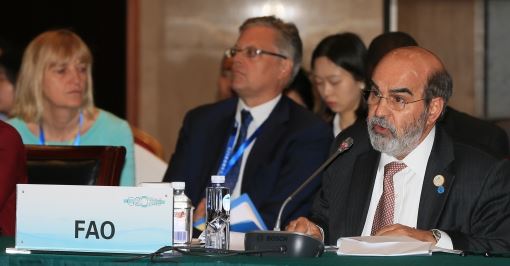
The G20 Ministers of Agriculture have affirmed the importance of Information and Communication Technology (ICT) at the end of their meeting, reports NaijaAgroNet.
A communique from the meeting made available to NaijaAgroNet, the ministers affirmed the importance of ICT in agriculture, calling it “essential to human, social and economic development,” and stressing “the potential to reach farmers --including smallholders and family farmers-- with timely and accessible content on markets, sustainable and efficient farming practices and new technologies

The partnership structured at the G20 meeting, NaijaAgroNet gathered is part of a larger digital strategy Food and Agriculture Organisation (FAO) is developing  to integrate a wide range of technologies, ranging from satellite data to mobile phones and social platforms, with the agency’s work to support the most vulnerable with access to information and bottom-up learning.

“We have to bear in mind that small farmers in developing countries are often constrained in their access to inputs, technology, and markets. In order to ensure that farmers fully leverage the ICT opportunities, it is essential to provide digital tailored access, foster capacity development and facilitate the exchange of experiences,” he said.

The FAO Director-General, José Graziano da, highlighted joint work between FAO and G20 countries on such projects as the Agricultural Market Information System (AMIS), the Tropical Agriculture Platform (TAP) and the G20 Technical Platform for the Measurement and Reduction of Food Loss and Waste.

He also underlined the ongoing international efforts to address Antimicrobial Resistance in partnership with the World Health Organization and the World Organization for Animal Health and called on G20 countries to support FAO in this endeavour. 
... Linking agrobiz, sustainable environs, people & technology
Continue reading