Think Agric: Agrotech on Edge of Second Green Revolution – Weilbach


Agribusiness industry leader at PwC Africa, FransWeilbach, has said that agriculture is currently standing on the edge of a second green revolution with the aid of technology, NaijaAgroNet reports.

Speaking on desperate need for food security, Weilbach said that as the global population is growing rapidly, innovative technology and advancements in productivity are becoming increasingly important as pressure mounts on food systems.

“It is predicted that technological innovation will act as a catalyst in lifting agribusiness to the next level in Africa. The winners will be those agribusinesses that seize the opportunity to create new opportunities through technology – they will be able to reach their strategic goals faster and more efficiently,” he said.

Also commenting, the PwC Director in Kenya, Edward Kerich, said “Kenya relies heavily on the agricultural sector as the mainstay of its economy, with agriculture contributing 29 per cent of GDP. Kenya is SSA’s leading tea exporter and one of the world’s largest black tea producers. A significant development in the agricultural sector is growth in the number of privately owned tea factories outside of those owned by the KTDA and the large multinationals in the country, and the benefits realized is expected to increase as some factories move to cheaper renewable energy such as hydropower production.”

PwC Partner in Nigeria, Rasheed Rahji said “Agriculture contributed 24.18% to real GDP in Nigeria in Q4 2015 and this is mainly due to mechanised farming and to other activities in the agribusiness value chain.”

NaijaAgroNet gathered that human resources (HR) models and processes are beginning to evolve, with more emphasis being placed on technology to improve networks and data.

Though industry analysts observed that majority of agribusinesses view climate change as having significant impact on SSA agriculture in the future – 41.2 per cent indicated that there will be a significant impact in the short term, while 35.3 per cent said there will be an impact over the next 20 years.

Meanwhile, NaijaAgroNet reports that agribusiness leaders are considering investing in renewable energy, the main forms of energy being considered are solar energy and biogas.

Okoli Vincent/GEE


... Linking agrobiz, sustainable environs, people & technology
Continue reading

G20 Ministers of Agriculture Affirm Importance of ICT

The G20 Ministers of Agriculture have affirmed the importance of Information and Communication Technology (ICT) at the end of their meeting, reports NaijaAgroNet.
A communique from the meeting made available to NaijaAgroNet, the ministers affirmed the importance of ICT in agriculture, calling it “essential to human, social and economic development,” and stressing “the potential to reach farmers --including smallholders and family farmers-- with timely and accessible content on markets, sustainable and efficient farming practices and new technologies

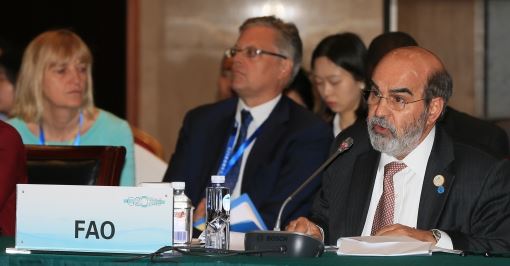
The partnership structured at the G20 meeting, NaijaAgroNet gathered is part of a larger digital strategy Food and Agriculture Organisation (FAO) is developing  to integrate a wide range of technologies, ranging from satellite data to mobile phones and social platforms, with the agency’s work to support the most vulnerable with access to information and bottom-up learning.

“We have to bear in mind that small farmers in developing countries are often constrained in their access to inputs, technology, and markets. In order to ensure that farmers fully leverage the ICT opportunities, it is essential to provide digital tailored access, foster capacity development and facilitate the exchange of experiences,” he said.

The FAO Director-General, José Graziano da, highlighted joint work between FAO and G20 countries on such projects as the Agricultural Market Information System (AMIS), the Tropical Agriculture Platform (TAP) and the G20 Technical Platform for the Measurement and Reduction of Food Loss and Waste.

He also underlined the ongoing international efforts to address Antimicrobial Resistance in partnership with the World Health Organization and the World Organization for Animal Health and called on G20 countries to support FAO in this endeavour. 
... Linking agrobiz, sustainable environs, people & technology
Continue reading

Ghana Launches US$113m Agric Project


NaijaAgroNet:
A six-year project worth US$113million, about N22.4bn to promote and scale-up agricultural value chains tagged ‘Ghana Sector Investment Programme’ (GASIP) has been launched in Tamale, Ghana, NaijaAgroNet reports.

The project which is being funded by the International Fund for Agriculture Development (IFAD) – a United Nations Food Agency – and implemented by the Ministry of Food and Agriculture (MOFA) is aimed at supporting infrastructure development, technology transfer, conservation farming and research to ensure the production of quality food crops to meet demands of the market.

GASIP, NaijaAgroNet gathered is anticipated to help about 12,000 rural households, especially women and young people to improve their economic activities and livelihoodsand is a great step towards realising Ghana’s medium-term agricultural sector investment (METASIP).

The implementation of GASIP is intended to drive its policy to enhance the economy and was designed differently from past projects wherein supply-driven projects such as roads, irrigation schemes and warehouses were pre-determined at the design stage — which resulted in several “white elephants” because the project designers assumed they knew what the people wanted.

Okoli Vincent/GEE

... Linking agrobiz, sustainable environs, people & technology
Continue reading