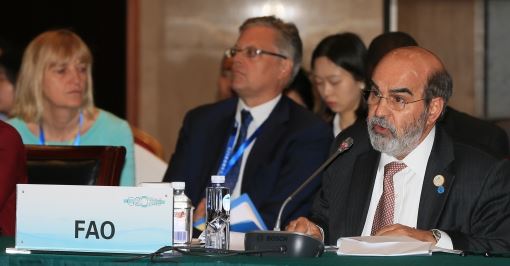
G20 Ministers of Agriculture Affirm Importance of ICT

The G20 Ministers of Agriculture have affirmed the importance of Information and Communication Technology (ICT) at the end of their meeting, reports NaijaAgroNet.
A communique from the meeting made available to NaijaAgroNet, the ministers affirmed the importance of ICT in agriculture, calling it “essential to human, social and economic development,” and stressing “the potential to reach farmers --including smallholders and family farmers-- with timely and accessible content on markets, sustainable and efficient farming practices and new technologies

The partnership structured at the G20 meeting, NaijaAgroNet gathered is part of a larger digital strategy Food and Agriculture Organisation (FAO) is developing  to integrate a wide range of technologies, ranging from satellite data to mobile phones and social platforms, with the agency’s work to support the most vulnerable with access to information and bottom-up learning.

“We have to bear in mind that small farmers in developing countries are often constrained in their access to inputs, technology, and markets. In order to ensure that farmers fully leverage the ICT opportunities, it is essential to provide digital tailored access, foster capacity development and facilitate the exchange of experiences,” he said.

The FAO Director-General, José Graziano da, highlighted joint work between FAO and G20 countries on such projects as the Agricultural Market Information System (AMIS), the Tropical Agriculture Platform (TAP) and the G20 Technical Platform for the Measurement and Reduction of Food Loss and Waste.

He also underlined the ongoing international efforts to address Antimicrobial Resistance in partnership with the World Health Organization and the World Organization for Animal Health and called on G20 countries to support FAO in this endeavour. 
... Linking agrobiz, sustainable environs, people & technology
Continue reading

Innovation Systems Research: Where We Came from & Where We Could Go

Published on 19 May 2016. Hyderabad, India. Presentation by Dr Andy Hall Project leader-Food Systems Innovation Agriculture Flagship Commonwealth Scientific Industrial and Research- -Organization (CSIRO) AUSTRALIA

Agricultural innovation systems (AIS) is a global perspective accidently invented by ICRISAT nearly 20 years ago. At that time ICRISAT along with the rest of the CGIAR was struggling with the question of how to improve the impact of its research. Partnership with the private sector as a way of achieving impact was a highly controversial idea. The failure of impact assessment research to make a difference and help set priorities could only be discussed in hushed whispers.

AIS thinking explained why partnership was critical for innovation. It explained why we needed to shift from measuring impact to learning how to achieve it. And it explained why (institutional) innovations in the innovation process were a critical part of an organization’s, a sector’s and a country’s capacity to innovate. Unsurprisingly it took many years before these ideas started to become main streamed and uncontroversial, but in the process many misunderstanding and confusion have crept in. 

The promise remains that AIS can 
  1. be used operationally to help navigate and progress the process of innovation in different contexts and 
  2. it can help frame a missing learning and research enquiry on how innovation and impact at scale really happens. 
Like all promises, there is work to do to keep that promise. So why not do it at ICRISAT where it all started? 


Related:
12 - 16 May 2016. Hack4Farming was an exciting event and part of ICRISAT’s digital agricultu
re initiative to achieve the Sustainable Development Goals, supported by Microsoft, aWhere, USA and T-Hub. Digital technology can accelerate the pace of developing and delivering sustainable and equitable solutions to smallholder farmers and in so doing enable us to achieve the Sustainable Development Goals before 2030. This includes narrowing the knowledge gap between researchers and farmers; providing timely and targeted information to farmers to manage weather and market variability and integrating farmers into profitable markets.

Over 100 data analysts, hardware buffs and software developers came together with agriculture domain experts at a two-day hackathon, titled Hack4Farming, to explore digital solutions to address agricultural development issues in India.

Hack4Farming focused on weather and systems modeling, and their potential impacts on the Indian agriculture sector. Teams explored how to leverage new modeling techniques (from ICRISAT), weather data (from aWhere, USA) and Intelligent Cloud (from Microsoft) to address the information gaps, and benefit the agriculture stakeholders including seed producers, service providers and farmers across India.

Share
Continue reading

G7 leaders’ declaration on food security and nutrition:

26 - 27 May 2016. Ise-Shima, Japan. Meeting of the G7 Ministers and high representatives, and the European Commissioner responsible for the environment. This meeting follows 2015 global commitments including the 2030 Agenda for Sustainable Development, the Paris Agreement on Climate Change and the Sendai Framework for Disaster Risk Reduction and the Addis Ababa Action Agenda. The meeting covered seven themes: the 2030 Agenda, Resource Efficiency, Biodiversity, Climate Change, Chemicals Management, the Role of Cities and Marine litter. 

 G7 leaders’ declaration on food security and nutrition:
“Ending hunger and malnutrition is a fundamental element of the 2030 Agenda. As part of a broader effort to achieve the SDGs, we commit to engage collectively in concrete actions in collaboration with relevant partners and stakeholders towards the achievement of our aim to lift 500 million people in developing countries out of hunger and malnutrition by 2030. Building on the G7 Broad Food Security and Nutrition Development Approach, we endorse the G7 Vision for Action on Food Security and Nutrition"
The G7 Vision for Action on Food Security and Nutrition outlines collective actions in the priority areas of:
  1. empowering women; 
  2. improving nutrition through a people-centered approach that recognizes the diverse food security challenges people face across the rural to urban spectrum; and 
  3. ensuring sustainability and resilience within agriculture and food systems. 
We commit to enhance synergies with relevant international initiatives. We support the development of good practices for global food security and nutrition that are in line with the SDGs and the Paris Agreement on climate change. This could include expanding farming opportunities, revitalizing rural communities, and enhancing production, productivity, responsible investment, trade and sustainability in agriculture and food systems. We welcome the International Symposium on Food Security and Nutrition to be held in Japan and the Nutrition for Growth Summit.”
Extract of the V4a (Vision for Action) (page 4)
Enhanced synergies and engagement with broad stakeholders and other fora: 
The G7 will seek further synergies with the G20 and its efforts on food security and nutrition, as well as collaboration with regional efforts and fora such as the Comprehensive Africa Agriculture Development Programme (CAADP), taking into consideration each region’s specific context and challenges and adjusting approaches where necessary, including by utilizing such opportunities as the Sixth Tokyo International Conference on African Development (TICAD VI: 27 to 28 August 2016 in Nairobi, Kenya).

Recalling the Addis Ababa Action Agenda, the G7 emphasizes the critical importance of mobilizing multiple streams of financing to achieve the 2030 Agenda. The G7 will work with relevant stakeholders to more effectively and sustainably mobilize resources for food security, complementing a similar exercise by the SUN Movement for nutrition. The G7 welcomes further efforts in leveraging private investments such as that demonstrated in the Global Agriculture and Food Security Program (GAFSP). 

The G7 will raise awareness on the issues that this V4A puts forward, and promote aligned actions and coherence in implementation, among all stakeholders including developing country partners, other donors, including through the Global Donor Platform for Rural Development (GDPRD), international and regional organizations, multilateral development banks, researchers and academics, and philanthropic organizations. The G7 will foster continued collaboration with the private sector and civil society, including through the New Alliance for Food Security and Nutrition. The G7 will seek opportunities to engage in multi-stakeholder dialogue, making full use of relevant fora and platforms on food security and nutrition, particularly the CFS.

Forthcoming:
  • Symposium on Food Security and Nutrition Japan 
  • 4th of August 2016. The Second High Level Summit on Nutrition will be held in Rio de Janeiro, Brazil. It is the biggest global event between now and 2020 to address the devastating burden of undernutrition.
Share
Continue reading

Awarded grants of the Dutch Food & Business Global Challenges Programme Call

20 May 2016. Five Integrated Projects have been awarded grants within the third Call of the Food and Business Global Challenges Programme (GCP). The theme of the NWO-WOTRO Call, selected and developed by the Food & Business Knowledge Platform (F and BKP), is “Transformation of food systems with a focus on sustainability and urbanization.”

Please find below a list of this month’s awarded Integrated Projects, linking to their own Research Projects page on this website.

Sustaining food supplies and improving health: Integration of small farmers into modern value chains with food safety standards in Kenya
Contamination with fungal toxins is a prominent food safety concern in tropical regions. Aflatoxin, a fungal toxin common in maize and groundnut, affects much of African produce. Besides exacting a significant health toll, it impedes farmers’ access to global food markets and high-value domestic markets. This project will develop and test business models to support the scale-up of a biocontrol product - Aflasafe, to combat aflatoxin among smallholder maize farmers in Kenya.

Cocoa crop improvement, farms and markets: a science-based approach to sustainably improving farmer food security in Ghana and Ivory Coast
Cocoa farmers in West Africa face poor productivity due to constraints at the crop, field, farm and sector level. To ensure farmers’ livelihoods, yields need to increase sustainably. This research will investigate the effect of field level practices on cocoa productivity. The suitability of different (combinations of) practices for different smallholder farm systems in Ghana and Ivory Coast will be explored. Effective delivery of the services supporting these practices will be co-developed with public and private partners.

Scaling-up nutrition-sensitive agricultural initiatives in poor mountainous areas in Vietnam and Lao PDR
Food insecurity and malnutrition remain persistent challenges among upland populations in Asia. Interventions are often fragmented and address immediate rather than underlying causes. Nutrition-Sensitive Agriculture (NSA) is a relatively new inter-sectoral, multi-level food system approach aiming to maximise agriculture’s contribution to improved food security and nutrition. Building upon existing interventions in Vietnam and Lao PDR, this project generates evidence on the effectiveness of, and best way to scale-up, NSA amongst ethnic minorities in mountainous areas.

Fish for food security in city regions of India and Ghana: an interregional innovation project (Fish4Food)
Seafood is vital to the health and food security of millions of poor consumers in rapidly expanding city regions in the global south. This project aims to understand how low-price fish chains contribute to urban food security in India and Ghana and to identify policy and business interventions that have potential to improve them.

Horticultural food systems based on ecologically intensive production and socio-economically sustainable value chains in the transition economies Chile and Uruguay (HortEco)
While consumption of vegetables in emerging economies falls well short of dietary recommendations, vegetable production contributes to environmental pollution and health risks. This project will engage with small farmers and organizations involved in low-or-no-pesticide production methods in Chile and Uruguay to develop more effective production, knowledge sharing methods and collaborative value chains.
Share
Continue reading