Youth in Agriculture in sub-Saharan Africa

On September 30, 2015, the Alliance for a Green Revolution in Africa (AGRA) launched the 2015 Africa Agriculture Status Report in Lusaka, Zambia. This report was specifically focused on "Youth in agriculture in sub-Saharan Africa", highlight the challenges and the opportunities for African youth in agriculture. CTA, via the ARDYIS project, contributed two chapters on: "Innovative and Inclusive Finance for Youth in Agriculture" and "ICT and Youth in Agriculture" to the status report.


In justifying the focus on youth, AGRA pointed out a post-launch press release on its website that: "Youth participation all along the value chain is vital to the growth of the agriculture-based economies of most African countries – from agricultural research and development, to food production, storage and handling, to agroprocessing, through to marketing and distribution in local, regional and international food markets. African youth present an unprecedented opportunity to deal with the constraints and challenges holding back improvements in agricultural productivity. Channeling the energy, strength, and dynamism of Africa’s youth into productive, competitive and profitable agribusinesses (including food production) will boost agricultural productivity, ensure sustainable food production system, create jobs, and generate incomes. The impact of youth involvement and participation in agriculture and food systems will be seen in sustainable economic growth, and in the reduction of poverty and malnutrition across the continent."

CTA Contributions

The chapter on "Innovative and Inclusive Finance for Youth in Agriculture" (chapter 4 in the report), highlighted the weak link between youth agripreneurs and formal financial institutions, including the scarcity of venture capital firms to support young entrepreneurs. It suggested alleviating these challenges for example through innovative financial means that required fewer or no assets or fixed collateral; such as contract farming, leasing, warehousing receipt, including socially innovative ways like crowdfunding.

On the other hand, the chapter on "ICT and Youth in Agriculture" (chapter 5) explored ICT for agriculture status and trends in Africa, and examined the roles ICTs are playing in supporting youth involvement in the sector. It also illustrated how youth are contributing to strengthening agricultural value chains through ICT innovations. It finallly discussed the current challenges relating to ICT use by youth (agricultural entrepreneurs, ICT entrepreneurs venturing in agriculture or other youth active in the sector) and suggested ways that those problems can be resolved.

Conclusions

In the end, as also expressed in the release quoted earlier, "the report is an affirmation and recognition of the prominent role of youth in transforming SSA agriculture and their vital contribution to engendering a uniquely African green revolution. Youth are vital to development and growth across Africa. The hope is that all stakeholders – whether from the public or private sector, or from government or non-governmental organizations working to transform African agriculture – will recognize the importance and potential of Africa’s youth and wisely invest in them to reduce poverty, end hunger, and ensure healthy lives and wellbeing for all at all ages."

Download the full report here
Continue reading

The Citrus Innovation Platform of Ghana

19 February 2016. Kade (120 Km from Accra, Ghana) Eastern Region citrus producers.

Since 2014, the Sub Saharan Challenge Programme (SSA CP, managed by FARA) has supported the PAEPARD Citrus consortium with an amount of 100,000$. The objective was to build the capacity of its members to work as an Innovation Platform (IP). The consortium has evolved in an IP at country level known as the Citrus Innovation Platform (CIP) of Ghana. This is a strategic IP which oversees 3 regional platforms in:
  1. Kumasi (for Ashanti region), 
  2. Kade (Eastern Region), 
  3. Assin Foso (Central Region).
The SSA CP support closed on 19th February 2016. GIZ came in also to build and strengthen the capacity of citrus producers and has sensitized some producers who were not initially in IPs to join them.

Very recently ECOWAS has funded the Fruit Fly Project in 8 countries (including Ghana, Cote d’Ivoire, Burkina Faso, Senegal, Mali etc.) with a total amount of 23,312,000 USD for 3 years. Professor Kwame Afreh-Nuamah of School of Agriculture, College of Basic and Applied Sciences, University of Ghana, is the Chairman of the Fruit Fly National Committee. He attended the workshop. He said that the chairman of the Citrus Innovation Platform will be included in the Committee and will seat in the next meeting planned in April.

CORAF has also funded the ARD component (research) of the Fruit Fly Project with 2.5 million USD. In Ghana this component is led by Dr Maxwell K. Billah of University of Ghana who attended the workshop as well.
Background:
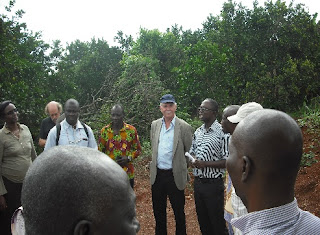
EC reviewers' Field visit on 22nd September 2015
  • The SSA CP is a FARA program funded by the European Commission through IFAD. The program has specialized in Integrated Agricultural Research Development (IAR4D) with the Integrated Innovation Platform (IP) approach where researchers, private sector including banks, NGOs, farmers create/form a forum to reflect and invent solutions to their challenges. 
  • SSA CP has facilitated the creation of IPs across the continent. Through PAEPARD they entered in contact with the Ghana citrus association. After discussion, two members (a researcher and a farmer) of the Citrus consortium were sent to Rwanda to learn the experience of IP. The support from FARA under the SSSA CP funding amounts to 100,000 USD
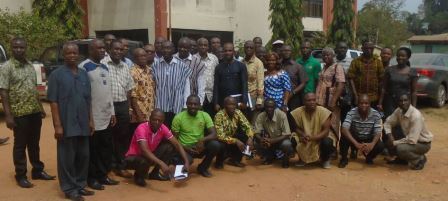
  • A training on IP management involved some 30 members of the citrus producers association and researchers. It was organized in Kumasi in August 2014. A field visit was organised and the Mankranso.
  • The IP was officially launched in the presence of the District Chief Officer, two members of the Parliament of Ghana and many other dignitaries.
Share
Continue reading

El Niño may have devastating impact on Southern Africa’s harvests


The quadruple of the Food and Agriculture Organization of the United Nations (FAO), the Famine Early Warning Systems Network (FEWS NET), the European Commission's Joint Research Centre (JRC) and the World Food Programme (WFP) have raised an alarm thatEl Niño may have devastating impact on Southern Africa’s harvests, reports NaijaAgroNet.
In a joint press statement made available to NaijaAgroNet, they also noted that Southern Africa is currently in the grip of an intense drought that has expanded and strengthened since the earliest stages of the 2015-2016 agricultural season, driven by one of the strongest El Niño events of the last 50 years.

They also noted that across large swathes of Zimbabwe, Malawi, Zambia, South Africa, Mozambique, Botswana, and Madagascar, the current rainfall season has so far been the driest in the last 35 years. Agricultural areas in northern Namibia and southern Angola have also experienced high levels of water deficit.

Equally, NaijaAgroNet gathered that much of the southern African sub-region has consequently experienced significant delays in planting and very poor conditions for early crop development and pasture re-growth. In many areas, planting has not been possible due to 30 to 50 day delays in the onset of seasonal rains resulting in widespread crop failure.

Experts noted that although there has been some relief since mid-January in certain areas, the window of opportunity for the successful planting of crops under rain-fed conditions is nearly closed.

Seasonal forecasts from a variety of sources are unanimous in predicting a continuation of below-average rainfall and above-average temperatures across most of the region for the remainder of the growing season.

The combination of a poor 2014-2015 season, an extremely dry early season (October to December) and forecasts for continuing hot and drier-than-average conditions through mid-2016 suggest a scenario of extensive, regional-scale crop failure.

In addition, South Africa has issued a preliminary forecast of maize production for the coming harvest of 7.4 million tonnes, a drop of 25 percent from the already poor production levels of last season and 36 percent below the previous five-year average.

These conditions follow a 2014-2015 agricultural season that was similarly characterized by hot, dry conditions and a 23 percent drop in regional cereal production. This drop has increased the region’s vulnerability due to the depletion of regional cereal stocks and higher-than-average food prices, and has substantially increased food insecurity.

The numbers of the food insecure population are now increasing due to the current drought and high market prices. It is expected that the population in need of emergency food assistance and livelihood recovery support will increase significantly.

+Naija AgroNet 

... Linking agrobiz, sustainable environs, people & technology
Continue reading

$5,000 Seed Funding Up for Youth Agripreneurs


The Global Forum on Agricultural Research (GFAR), Young Professionals for Agricultural Development (YPARD) and Consultative Group for International Agricultural Research (CGIAR) have launched a pilot project tagged Youth Agripreneurs Project (YAP) beginning with the seed funding of 5,000 USD, reports NaijaAgroNet.

GFAR Social Media Coordinator, Mr. Peter Casier, said that the project was in recognition of the crucial importance of young farmers, and the role of small entrepreneurship.

The Youth Agripreneurs Project, he said, is a pilot project providing seed funding (US$5,000) to young agriculture entrepreneurs.

According to him, there is more, we'll integrate them in an extensive one year mentoring, online media training via advocacy and online networking are essential for young agripreneurs, and follow-up programme to ensure their agripreneurs project becomes a success.

“We have a solid support infrastructure in combination of
GFARCGIAR and YPARD resources; have the basic funding in place,” he said.

Casier also commended the first sponsors, namely the International Fund for Agricultural Development
(IFAD) and Agropolis Fondation.

He disclosed they have a solid project outline which was participatory designed together with a large group of YPARD youth. Just as they plan an online media training package at the upcoming 
#GCARD3 Global Consultation in South Africa and a well-oiled and tested YPARD mentoring programme.
 

... Linking agrobiz, sustainable environs, people & technology
Continue reading

Expert Says Agro-biotechnologies Essential in Fighting Hunger


The Director-General of the Food and Agriculture Organisation (FAO) José Graziano da Silva has said that agro-biotechnologies are essential in fight against hunger, reports NaijaAgroNet.

Addressing the opening session of the FAO-hosted international symposium on "The Role of Agricultural Biotechnologies in Sustainable Food Systems and Nutrition the need for a broad portfolio of tools and approaches to eradicate hunger, fight every form of malnutrition and achieve sustainable agriculture." 

"As a neutral forum, FAO has been promoting debates, dialogues and exchanges of information in order to enhance our knowledge of these tools and approaches," the DG said.

The symposium, de Silva said, focuses mainly on the broad range of biotechnologies that could result in yield increases, better nutritional qualities, and improved productivities of crops, livestock, fish and trees benefitting family farmers and their food systems, nutrition and livelihoods. 

These, he said, include many "low tech" applications, for example fermentation processes, bio-fertilizers, artificial insemination, the production of vaccines, disease diagnostics, the development of bio-pesticides and the use of molecular markers in developing new varieties and breeds.

"We cannot lose sight that biotechnologies, knowledge and innovation must be available, accessible and applicable to family farmers including small holders," Graziano da Silva told symposium participants. "We must find the means to remove the barriers that prevent their availability to family farmers.

The symposium,he said, is not about genetically modified organisms (GMOs), pointing out that agricultural biotechnologies are much broader than GMOs.

About 500 scientists, representatives of government, civil society, the private sector, academia, farmers' associations and cooperatives are participated in the three day event.

Isaac Oyimah/GEE 
... Linking agrobiz, sustainable environs, people & technology
Continue reading