Africa

Symposium on Climate Change Adaptation in Africa

21 - 23 February 2016. Addis Ababa, Ethiopia. Symposium on Climate Change Adaptation in Africa. This symposium was organised by Manchester Metropolitan University (UK), Addis Ababa University, the Research and Transfer Centre “Applications of Life Sciences” of the Hamburg University of Applied Sciences (Germany) and the International Climate Change Information Programme (ICCIP). 

The Symposium was an interdisciplinary event, mobilising African and non-African scholars undertaking research and/or executing climate change projects in the African continent. It focused on “fostering African resilience and capacity to adapt”, showcasing experiences from research, field projects and best practice in climate change adaptation in African countries, which may be useful or implemented in other countries in the continent.

Extracts of the pogramme: Climate Change and Agriculture 
  • Empirical Analysis of Climate Variability and Impact on Nigerian Agricultural Production Olawale Emmanuel Olayide, University of Ibadan, Nigeria 
  • Silvopastural systems using indigenous fodder trees and shrubs: the underexploited synergy between climate change adaptation and mitigation in the livestock sector Mulubrhan Balehegn Gebremikael, Mekelle University, Ethiopia 
  • Potential for Scaling up Climate Smart Agricultural Practices: Examples from Sub Saharan Africa, CIMMYT
  • Adaptation to Climate Change in Egyptian Marginal Environments through Sustainable Crop and Livestock Diversification: A Case Study Hassan M.EI Shaer, Desert Research Center, Egypt
  • Impacts of climate change and adaptation options for maize production in the Central Rift Valley of EthiopiaBelay Tseganeh Kassie, University of Florida, USA.
  • Approaches to adaptation of agriculture to climate change and variability: The Farm Input Subsidy Program (FISP) and the Green Belt Initiative (GBI) in MalawiFloney Patame Kawaye, Australian National University, Australia 
  • Adaptation Benefits of Climate-Smart Agricultural Practices in the Blue Nile Basin: Empirical Evidence from North-West Ethiopia Paulos Asrat, Addis Ababa University, Ethiopia 
  • Assessment of Weather Variability Impact on Rice Yield in South Western Nigeria Tawakalitu Bola Onifade, Ladoke Akintola University of Technology, Nigeria.

References:
Share
Continue reading
Africa, Agriculture

Role of agricultural biotechnologies in sustainable food systems and nutrition

Helen Altshul, BecA-ILRI Hub's development partnerships
specialist made a presentation at FAO symposium in Rome
(photo credit: FAO/Giuseppe Carotenuto)
15-17 February 2016. Rome, Italy. This technical conference explored how agriculturalbiotechnologies can benefit small-holder farmers, particularly those in developing countries, who need to improve nutrition and strengthen livelihoods even as their production systems are constrained by climate change, population growth, and other socioeconomic factors.  

Through a series of keynote speeches, presentations and side events, the contributions of a wide spectrum of biotechnologies to sustainable food systems and nutrition was covered. A high-level ministerial segment took place on 16 February.

Participants at the symposium included representatives from governments, intergovernmental bodies, the private sector, civil society, research and academic institutions, cooperatives, and other producer and farmer organizations.

Objectives:
  • The symposium focused mainly on the broad range of biotechnologies that could result in yield increases, better nutritional qualities, and improved productivities of crops, livestock, fish and trees on which smallholder farmers’ food systems, nutrition and livelihoods depend. 
  • These biotechnologies encompass a wide range of low-tech to high-tech approaches which can make the development of improved varieties and breeds that adapt to the effects of climate change, faster and more efficient. 
  • Some permit the rapid diagnosis of diseases and pests while others are used in vaccine production and the reduction of the environmental footprints of agricultural production systems. 
  • The focus was on agricultural biotechnologies that are currently available and ready to use by smallholder producers, including low-tech approaches involving artificial insemination, fermentation techniques, biofertilizers etc. up to high-tech approaches involving advanced DNA-based methodologies. 
Highlight:
The increased use of biosciences by African national agricultural research systems (NARS) was highlighted by the BecA-ILRI Hub

In a presentation titled ‘Biosciences capacity building in Africa: lessons learned from the BecA-ILRI Hub’, development partnerships specialist Helen Altshul highlighted lessons learned from over a decade of supporting national programs in building their capacity to deliver on their national research mandate. Altshul emphasised the BecA-ILRI Hub’s demand-driven approach to research and capacity building underpinned by the Africa Biosciences Challenge Fund (ABCF) program. Through the ABCF, the BecA-ILRI Hub continues to contribute to strengthened research capabilities of individuals and institutions within NARS in Africa.

The presentation demonstrated how the BecA-ILRI Hub’s focus on enabling research innovations has produced important discoveries led by national researchers including:
  • Isolation of the new virus in pigs by scientists from Uganda and Kenya led by Charles Masembe from Makerere University in Uganda;
  • Production of new cross between maize and sorghum for crop improvement by Alexander Bombom from the Ugandan National Agricultural Research Organization (NARO);
  • Utilizing genetic diversity of local African chicken to improve productivity by Christian Keambou from the University of Buea in Cameroon; and
  • Contribution to the release of new sorghum varieties in Sudan by Rasha Mohamed from the Agricultural Research Cooperation
Share
Continue reading
Agriculture

Professionalisation of family farming

10 February 2016. CTA has recently co-published with ISF Cameroon a book aimed at supporting development of the farming family sector.

Professionalisation of family farming – Tools for technical and organisational capacity-building of farmers’ organisations in sub-Saharan Africa
Author: Jean Merlin Etobe
CTA 2015, 54 pages

Goal 
The goal of this guide is to promote the professionalisation of farmers’ organisations through the implementation of technical and organisational capacity-building tools.

The top-down approaches giving donors, governments and their experts a monopoly on designing and decision-making are now called into question. They are now tentatively being replaced by bottom-up approaches, which allow the population to integrate their initiatives into the measures taken by the decision-makers.

We need to give priority to the stakeholders’ viewpoints and bottom-up approaches. But the smooth transition from an administered development to a concerted development requires conditions that are not always present. While various professions try to join together in order to better protect their interests and e…ciently contribute to their country’s development, agricultural producers seem to be lagging behind. 

Their weak organisational capacities might be the cause of this delay. In order for farmers to be recognised as stakeholders in their own right and for them to meet the high expectation of feeding the world by producing more and better and with less means, we must form strong, representative and professional farmers’ organisations.
Target audience 
This guide is mainly directed at the various stakeholders of rural development in sub-Saharan Africa. They are mainly:

  • members of producer organisations, cooperatives, village associations, economic interest groups, common interest groups, etc. 
  • executives and development workers in rural development projects and programmes 
  • leaders of the farming world 
  • farm schools students and pupils; 
  • anyone who wants to create a farmers’ organisation within a rural community.
Share
Continue reading
Funding & Opportunities

Call for Proposals: Sustainable Inclusive Value Chains and Food Fortification


25 February 2016. Brussels. EU public information session on the launch of two calls for proposals with a combined value of €57 million with the objective of developing inclusive and sustainable agriculture-based value chains (Lot 1) and fortified foods (Lot 2) that improve food security for the poor and vulnerable and that reduce poverty and under-nutrition. 
  1. Lot 1 specifically focuses on smallholder farmers and micro, small and medium enterprises (MSME) agribusinesses in developing countries as final beneficiaries by increasing income opportunities, creating jobs and business opportunities along the agricultural supply chains in an inclusive and sustainable manner.
    Lot 1 – Value Chains (S.O. 1 & 2):  EUR 27 million.
  2. Lot 2 aims to strengthen the production, diffusion and consumption of accessible technologically viable and culturally acceptable fortified food, compliant with national and international standards. It will involve working with government and intergovernmental regulatory bodies, the food processing private sector operators and civil society, reinforcing public-private partnerships.
    Lot 2 – Food Fortification (S.O. 3): EUR 30 million
    Background:
    1. This call was launched on 12 February and is open until 29 March 2016.
    2. In order to be eligible for a grant, the lead applicant must be among one of the following eligible countries in LDCs and other low income countries from Africa (see however the full list in the Guidelines for grant applicants.docx)(c) Least developed countries (LDC) : Angola, Benin, Burkina Faso, Burundi, Central African Republic, Chad, Comoros, Democratic Republic of the Congo, Djibouti, Equatorial Guinea, Eritrea, Ethiopia, Gambia, Guinea, Guinea-Bissau, Lesotho, Liberia, Madagascar, Malawi, Mali, Mauritania, Mozambique, Niger, Rwanda, Sao Tome & Principe, Senegal, Sierra Leone, Somalia, Sudan, South Sudan, Tanzania, Togo, Uganda, Zambia
      (d) Other low income countries: Kenya, Zimbabwe
    3. Any requested EU contribution (amount) under this call for proposals must fall between the following minimum and maximum amounts:

      Lot 1 – Value chains:

      • minimum amount: EUR 3 million

      • maximum amount: EUR 7 million

      Lot 2 – Food fortification:

      • minimum amount: EUR 1 million

      • maximum amount: EUR 4 million
    4. Full details of the call are available here
    5. A public information session about these calls, lasting more than one hour, took place on 25 February 2016. 
    6. The video of the session is available here. "Probably a total number of 9 projects will be funded under this call": Regis Meritan (DG DevCo European Commission)
    Share
    Continue reading
    Africa

    The Citrus Innovation Platform of Ghana

    19 February 2016. Kade (120 Km from Accra, Ghana) Eastern Region citrus producers.

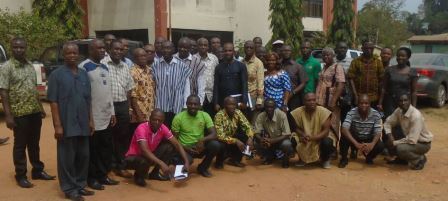
    Since 2014, the Sub Saharan Challenge Programme (SSA CP, managed by FARA) has supported the PAEPARD Citrus consortium with an amount of 100,000$. The objective was to build the capacity of its members to work as an Innovation Platform (IP). The consortium has evolved in an IP at country level known as the Citrus Innovation Platform (CIP) of Ghana. This is a strategic IP which oversees 3 regional platforms in:
    1. Kumasi (for Ashanti region), 
    2. Kade (Eastern Region), 
    3. Assin Foso (Central Region).
    The SSA CP support closed on 19th February 2016. GIZ came in also to build and strengthen the capacity of citrus producers and has sensitized some producers who were not initially in IPs to join them.

    Very recently ECOWAS has funded the Fruit Fly Project in 8 countries (including Ghana, Cote d’Ivoire, Burkina Faso, Senegal, Mali etc.) with a total amount of 23,312,000 USD for 3 years. Professor Kwame Afreh-Nuamah of School of Agriculture, College of Basic and Applied Sciences, University of Ghana, is the Chairman of the Fruit Fly National Committee. He attended the workshop. He said that the chairman of the Citrus Innovation Platform will be included in the Committee and will seat in the next meeting planned in April.

    CORAF has also funded the ARD component (research) of the Fruit Fly Project with 2.5 million USD. In Ghana this component is led by Dr Maxwell K. Billah of University of Ghana who attended the workshop as well.
    Background:
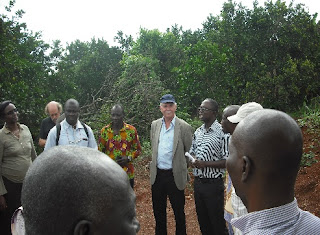
    EC reviewers' Field visit on 22nd September 2015
    • The SSA CP is a FARA program funded by the European Commission through IFAD. The program has specialized in Integrated Agricultural Research Development (IAR4D) with the Integrated Innovation Platform (IP) approach where researchers, private sector including banks, NGOs, farmers create/form a forum to reflect and invent solutions to their challenges. 
    • SSA CP has facilitated the creation of IPs across the continent. Through PAEPARD they entered in contact with the Ghana citrus association. After discussion, two members (a researcher and a farmer) of the Citrus consortium were sent to Rwanda to learn the experience of IP. The support from FARA under the SSSA CP funding amounts to 100,000 USD
    • A training on IP management involved some 30 members of the citrus producers association and researchers. It was organized in Kumasi in August 2014. A field visit was organised and the Mankranso.
    • The IP was officially launched in the presence of the District Chief Officer, two members of the Parliament of Ghana and many other dignitaries.
    Share
    Continue reading