










Snailery Design and Management
Housing

There are 2 main types of modern pen/systems in use – semi-intensive (paddock) system and Intensive (cage) system.
Paddock System: This system mimics the wild life but with some improvements. Snails are barricaded within an enclosure, where various plants are grown and water provided. Snails love vegetables cultured within the enclosure, which serves as food as well as protection from direct sun. Watering may be done by using a watering can (reasonable only for small paddock, but strenuous) or by Sprinkler.
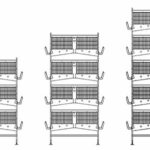
Cage System: Cages have the advantage of housing more snails per metre square. Depending on your management capacity, you may go as high as 30-40 snails/m². This is very intense, so ensure good hygiene such as quick faeces removal, cool environment, and pest management. The cage may be Single-layered or Tiered system.
Whatever system you choose, note that the design of a snail house must be anything that will prevent their escape, provide food and water, and also protect them from pests.
Snailery Management
There are four key factors to be considered when producing any animal, including snails. These are:
- The animal (snail): You should consider the breed i.e rate of growth and health status
- The housing/facilities: must be good, able to prevent rodents/pests
- Feed: should be removed daily – if it can easily spoil or become moist. Solids like eba, cake, diet, leaves etc may be left till the 3rd day. However, the best is to serve their feed once on a daily basis.
- Environment: Good ventilation; Porous soil – to avoid water logging; and Protection from heat. Let’s remember their wild habitat is cool and fresh.
Paddock Management
The paddock system is good and less expensive in terms of feeding the snails, but it is difficult when it comes to monitoring the snails as well as in carrying out hygiene. So, it is important to do the following;
- Culture your paddock till it is grown and fresh before stocking the snails.
- Transfer the adult snails there and provide water with sprinkler or shallow ditch.
- Serve their diet on alternative days or 2 to 4 times per week (optional).
- Leave them for a calculated period based on your aim, for like about 2 to 3 months, then remove and transfer the adults to another pen or sell them.
- Leave the hatchlings / juveniles to develop for about 6 to 8 months, depending on diet or care, so that they will reproduce at least once before harvesting.
If you check the slides, the stage management is when you shift the developing snails as they grow for like after three months to maximize space. That way, you can count or take stock when transferring them.
Also, ensure you are not using clay soil to avoid caking, trapping the eggs, or water logging. Sandy-loamy soil is good. Fertilize the soil before planting. You can use well- managed poultry faeces, if you are sure of its source, to avoid disease transfer.
Cage Management
For cage, record keeping is easy. You can read it up in the ebook. It’s similar to your poultry practice. Hand pick the adults, leaving the babes. If it’s easier for you, hand pick the babes and take stock.
Snail eggs are managed in an artificial incubator. You can use a box and keep in a warm place like a garage. Ensure the soil is good, preferably sandy soil because it is porous.

Once you notice that the hatching rate is reducing, disinfect the soil or change it. For good hatching, you need well-draining soil, low bacteria load, good humidity and a relatively high temp (25-350C). The higher the temp, the faster the hatching and survival. However, drying is a factor to contend with, just like in poultry hatchery.
You must select good breeds to get good returns. To select your stock;
Check the size/length/weight and compare with the number of sutures (shell turns). The snail with fewer shell turns, yet about the same length or size, is of better genetic quality. It means it is developing faster. So, after harvesting your stock, it is advisable you group your snails by sizes (length), then look for those with less number of sutures.
You may also compare the weight for similar sizes.
How To Identify Matured Snails
If you can count the number of shell turns, once it hits 5¼, the snail is about to start laying.
At 5½, it should have started laying. Snail eggs (for Am) are similar to lizard eggs.
As eggs is about ½length of Am, and Af about ½ length of Aa.


18 thoughts on “Snail Farming: All You Need To Know”
Thank you for the 8 information. please how can I know the males and females
This is quite informative Thank yo so much.
But please how can one take care of hatchlings from achatina fulica , they seem too tiny and extremely vulnerable.
Thanks for the information it’s really helpful
How do I control ant invasion?
Thanks for the information is helpful
Nice coming across tovyou
Thank you for engaging
I want to go into snail rearing shortly somewhere in Abia state, Nigeria. I want some advice on stocking as I intend to farm commercially.
https://air.zkg.mybluehost.me/product-category/livestock-section/book/livestock-ebooks/
You can buy our E-book on snail using the link above.
If you desire a consultation on your question: Kindly reach out via mail to: comms.afrimash@gmail.com
Thanks , this is quite helpful and educative.
Thank you for engaging